Press: AI avatars that join the discussion on stage
In short
Aura51.ai, from Horgen, Switzerland, brings AI avatars to the stage as discussion participants. They follow the debate and answer when the moderator calls them by name. The technology is being measured in live tests. Aura51.ai is a sole proprietorship of Oliver Schibli; it was founded by Oliver Schibli and Martin Radelfinger.
Last updated 2 October 2026
01What it is
A guest on the screen who joins in
Here is an example of how it sounds in the room. The moderator asks, in German, “Albert, wie siehst du das?” (Albert, how do you see it?). About two seconds after the last word of the question, the face on the screen starts to speak, with a short opener such as “Also.” (So.). The moderator sees the text of the actual answer on the tablet, usually a little over a second before the room hears it; only the opener does not appear there.
The AI avatar has been listening to the discussion and picks up on what was just said. It takes a stand from the position its briefing gives it and pushes back when it disagrees. If people in the room are merely talking about it, it stays quiet.
02Boilerplate
Two pieces of boilerplate, ready to use
You may use both versions as they are or shorten them.
- Boilerplate
Short version
Aura51.ai, based in Horgen, Switzerland, puts AI avatars on panels and stages as guests. They listen to the discussion. When the moderator calls on one of them by name, it answers from the position the organizer has set for it.
- Boilerplate
Long version
Aura51.ai, based in Horgen, Switzerland, brings AI avatars as discussion participants to conference panels, customer events, internal town halls and university events. The AI avatar appears on the screen with a face and a voice and listens to the discussion. It speaks when the moderator calls on it by name, and for a short while afterward it also answers follow-up questions without its name. The organizer sets its position in advance in the briefing. The moderator sees every answer as text on a tablet before the room hears what it says and can cut it off. Aura51 has four characters: Albert, the provocateur, Vera, the skeptic, Tina, the explainer, and Ken, the voice from outside. Aura51 runs the technology at the event itself. The system is measured in the lab and live, in tests on a laptop with people in the room. Aura51 was founded by Oliver Schibli and Martin Radelfinger.
03Facts
Facts at a glance
- Name
- Aura51.ai
- Location
- Horgen, Switzerland
- Legal form
- Sole proprietorship, owned by Oliver Schibli
- Service area
- Worldwide; the AI avatars speak standard German for now
- Founders
- Oliver Schibli and Martin Radelfinger
- Offering
- AI avatars as guests for conference panels, customer events, internal town halls, and education and university formats. We run the technology at the event ourselves.
- Lead time
- About two weeks, for coordination with the event’s AV team
- Characters
- Albert, the provocateur; Vera, the skeptic; Tina, the explainer; Ken, the voice from outside
- Languages
- Standard German for now; no Swiss German, no English yet
- Requirement
- An internet connection; the system does not work without one
- Status
- Beta. Technology measured in the lab and live, on a laptop with people in the room
- Next step
- Pilot engagements at events, on pilot terms
- Labeling
- On request, the video carries a notice for the entire appearance that an AI avatar is speaking.
04Measurements
Four numbers and how we got them
We measured in the lab and live with people in the room speaking freely. All four characters run on the same technology, so the figures apply to each of them.
Since the first live test, the median time to the first sound has roughly halved.
- 1.5–2 sto the first soundafter the last word of the call, live with people in the room; median about two seconds
- 334 msto silence after STOPtap on the moderator’s tablet, measured in the lab; live also under half a second
- 12 sconversation without a name calla setting, not a measurement; counted from the last sentence, after that it needs its name again
- 1.3 sfrom an interjection to the “Moment” linemeasured in the lab, from the triggered interjection and excluding speech recognition; not yet live
One number is missing on purpose, “under a second.” The lower limit for the first sound is about 1.5 s.
05Still open
What we cannot prove yet
One capability is not yet proven live: reacting to an interjection. If the moderator calls its name into its answer, it asks for a moment with a short line; so far we have measured this only in the lab.
Stopping by voice and knowing the guests’ names, on the other hand, have been measured live. A German “Danke” (thank you) with its name stopped it mid-sentence, and it fell silent after about a second. It addressed guests correctly by the names in the briefing.
That is why the two boilerplate texts above leave out interjections. If you mention them, please include the caveat.
06Founders
The founders come from media
Oliver Schibli is a media executive who has been programming since he was seven. His background is in digital ad sales. At Aura51, he wants to know what an AI can do when a whole room is listening.
Martin Radelfinger founded the firm Net Gain and is an author. His field is media economics, along with the growing importance of artificial intelligence for how brands and companies communicate.
07Images
None of the four faces belongs to a real person
On request, we send the logo and the portraits of the four characters. The faces were created entirely virtually. None of them was modeled on a real person, living or dead.
Please label the portraits as AI avatars in the caption, for example: “Albert, AI avatar by Aura51.ai. The face is not modeled on a real person.”
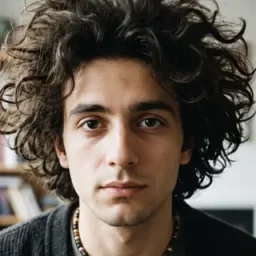 AlbertAI avatar
 VeraAI avatar
 TinaAI avatar
 KenAI avatar
08Contact
Media contact
Please send media inquiries and image requests to this address:
AURA51.AIEbnetstrasse 2
8810 Horgen
Switzerland
panel@aura51.ai